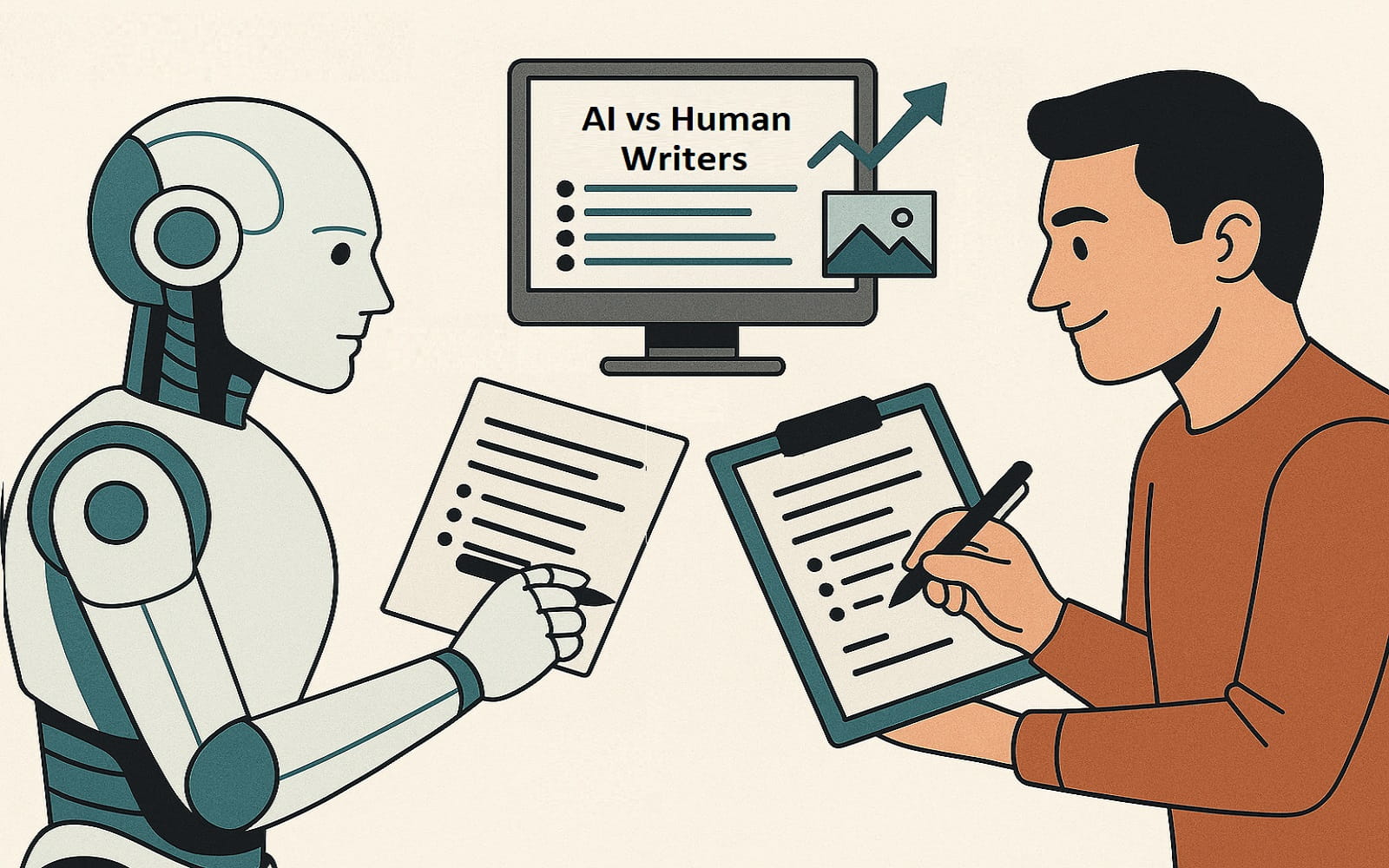
AI writing tools have moved from novelty to daily habit. They draft emails, summarize articles, generate blog posts, rewrite paragraphs, and even help shape marketing campaigns. At the same time, many people still trust human writing more—especially when the goal is to persuade, connect emotionally, or communicate complex ideas with real responsibility.
So who wins: AI or humans?
The most accurate answer is: it depends on what “winning” means. AI often wins on speed, scale, and structure. Humans still win on meaning, judgment, originality, and lived context. The future isn’t AI replacing human writers; it’s writers who know how to use AI intelligently outperforming those who don’t.
This article breaks down where each one truly excels, where each one fails, and how to combine them for the best results.
1) What AI Writing Is Actually Good At
AI models learn patterns from enormous amounts of text. They’re extremely good at predicting plausible next words and generating coherent sentences. That makes them strong at tasks where the main goal is language production, not deep understanding.
A) Speed and volume
AI can produce:
-
10 headline options in 10 seconds
-
5 outlines instantly
-
a full first draft in minutes
-
multiple variations of the same message
For businesses and creators who need content at scale—product descriptions, social captions, ad copy variants, FAQ drafts—AI can dramatically reduce time.
Where AI wins: when the bottleneck is “starting” or “producing enough options.”
B) Structure and formatting
AI tools are strong at turning vague ideas into organized formats:
-
blog outlines
-
meeting agendas
-
lesson plans
-
summaries and bullet points
-
templates (emails, proposals, scripts)
Many people struggle with structure more than ideas. AI shines as a “formatting engine” that helps your content look organized quickly.
Where AI wins: when you know what you want to say but need help arranging it.
C) Language support and clarity
AI can help non-native writers improve fluency and readability:
-
reducing awkward phrasing
-
fixing grammar and punctuation
-
simplifying complex sentences
-
adjusting tone (formal vs casual)
Used ethically, AI can be like an always-available writing coach that reduces language barriers and boosts confidence.
Where AI wins: when the goal is clarity, not originality.
D) Rewriting and repurposing
AI can efficiently convert a piece of content into other formats:
-
blog → LinkedIn post
-
long article → short summary
-
YouTube script → newsletter
-
technical notes → beginner-friendly explanation
This is especially useful in marketing and education where the same idea must be delivered in multiple formats.
Where AI wins: repackaging a known message for different audiences.
2) Where Human Writing Still Dominates
Human writing isn’t just about correct sentences. It’s about intent, taste, and responsibility. The strongest writing often comes from lived experience, deeper reasoning, and emotional truth—areas where AI struggles.
A) Original ideas and genuine insight
AI can remix common patterns. Humans can create:
-
original frameworks based on experience
-
truly novel metaphors
-
unique perspectives from real events
-
insight shaped by personal failures, wins, and context
Even if AI sounds insightful, it often repeats familiar takes because that’s what it has seen most.
Where humans win: originality that isn’t just recombination.
B) Emotional intelligence and authentic voice
Humans write with:
-
humor that fits the moment
-
empathy that responds to real people
-
voice built from identity and experience
-
storytelling that feels “true,” not generic
AI can imitate tone, but it often lacks the subtlety of real emotional context—like knowing when to be silent, when to be vulnerable, and when a sentence lands wrong.
Where humans win: authenticity, trust, and emotional resonance.
C) Moral judgment and accountability
AI doesn’t take responsibility. Humans do.
In high-stakes writing—medical, legal, financial, academic, or public policy—accuracy and ethics matter. AI can hallucinate facts, invent sources, and frame sensitive topics poorly.
Humans can:
-
check evidence
-
weigh consequences
-
avoid harmful claims
-
understand social and cultural context
-
choose what not to say
Where humans win: judgment, responsibility, and real-world consequences.
D) Deep understanding and nuance
AI can explain concepts well, but that doesn’t mean it understands them. Humans can:
-
reason from first principles
-
notice contradictions
-
spot subtle implications
-
connect ideas across contexts
-
interpret ambiguity correctly
For complex academic arguments, research synthesis, and thought leadership, that depth matters.
Where humans win: depth, nuance, and real comprehension.
3) Common Myths That Confuse the Debate
Myth 1: “AI writing is always lower quality.”
Not necessarily. AI can create solid drafts—especially for generic or informational content. The real issue is that AI often produces average writing. It’s decent, not distinctive.
Myth 2: “Human writing is always better.”
Also false. Humans are inconsistent, distracted, and biased. We ramble, repeat ourselves, and make avoidable grammar mistakes. AI can outperform many humans on clarity, structure, and basic correctness—especially under time pressure.
Myth 3: “AI will replace writers.”
AI will replace some writing tasks—particularly repetitive, low-stakes, template-driven work. But the best writing work depends on:
-
insight
-
strategy
-
taste
-
ethics
-
trust
-
expertise
Those are human strengths. The future is more likely: writers become editors, strategists, and creative directors of AI-assisted drafts.
4) Where Each One Wins: A Practical Comparison
Let’s break it down by real-world writing situations.
A) Blog posts and SEO content
-
AI wins: keyword-driven drafts, outlines, meta descriptions, FAQ sections, content repurposing
-
Humans win: unique angle, experience-based examples, strong storytelling, credible expertise, fact-checking
Best workflow: AI generates structure and variations; human adds insight, edits for voice, verifies facts.
B) Academic writing
-
AI wins: grammar improvement, clarity editing, outlining, summarizing your own notes
-
Humans win: original reasoning, argument development, source evaluation, ethical accountability, proper citation use
In academics, many institutions restrict AI usage. Ethical use matters more than speed.
C) Marketing and brand copy
-
AI wins: A/B test variants, headline generation, ad copy versions, product copy templates
-
Humans win: brand voice, emotional positioning, cultural nuance, strategic messaging, high-stakes campaigns
A brand isn’t just words—it’s trust. Humans are better at protecting it.
D) Email and workplace communication
-
AI wins: turning messy thoughts into clear emails, polite tone, quick rewrites
-
Humans win: relationship awareness, politics of the workplace, timing, and intention
AI can help you sound clearer. You must decide what’s appropriate.
E) Creative writing (fiction, poetry, scripts)
-
AI wins: idea prompts, plot variations, character bios, rewriting scenes in different styles
-
Humans win: emotional depth, originality, meaningful themes, authentic lived detail
AI can assist creativity, but human creativity gives it purpose.
5) Quality Risks: Where AI Often Loses
Even when AI produces fluent text, it has consistent weaknesses:
A) Hallucinated facts and fake citations
AI may produce believable but incorrect information. If your writing depends on accuracy (research, journalism, health), you must verify everything.
B) Generic tone and “AI voice”
Readers can sense when writing lacks specificity. AI often overuses:
-
broad claims
-
safe phrasing
-
repetitive transitions (“Moreover,” “In conclusion,” “Additionally”)
-
buzzwords without substance
C) Hidden bias and uneven reliability
AI models can reflect biases in training data. They may also treat fringe claims as mainstream or flatten nuanced debates.
D) Overconfidence
AI doesn’t know when it’s wrong. It can sound certain even when guessing.
6) Where Humans Often Lose (And AI Helps)
Humans have weaknesses too—and AI can genuinely help overcome them.
A) Writer’s block and slow starts
Many people can edit better than they can draft. AI is excellent at getting a “first version” on the page, which you can then refine.
B) Inconsistent clarity
Humans often assume readers know what we mean. AI can help translate your thoughts into reader-friendly language.
C) Time pressure
When deadlines are tight, AI can help create a workable draft faster—especially for routine writing.
7) The Best Strategy: Human-Led, AI-Assisted Writing
Instead of “AI vs. Human,” the practical approach is: human-led writing, AI-assisted execution.
Here’s a strong workflow that balances speed and quality:
-
Human sets the goal: audience, purpose, angle, constraints
-
AI generates options: outlines, headings, variations, draft paragraphs
-
Human adds expertise: real examples, opinions, data, and nuance
-
AI polishes: clarity, grammar, conciseness, tone adjustments
-
Human verifies and finalizes: fact-checking, citations, integrity, final voice
If you do this well, the output feels human—because it is.
8) A Simple “When to Use AI” Checklist
Use AI when:
-
you need a fast draft or outline
-
the content is low-stakes or internal
-
you’re repurposing existing ideas
-
you want multiple versions quickly
-
you need grammar and clarity support
Avoid AI (or use with strict caution) when:
-
accuracy is critical (medical, legal, financial)
-
you must cite sources (academic/research) without full verification
-
the writing must be deeply personal or sensitive
-
the content could harm reputation if wrong
-
the task is meant to test your own learning (exams/assignments)
Conclusion: The Real Winner Is the One Who Knows How to Combine Both
AI wins at speed, structure, and scale. Humans win at meaning, originality, emotional intelligence, and responsibility. In practice, the best results come from combining them: letting AI handle repetitive drafting and formatting while humans lead with insight, ethics, and intent.
